Know before
it breaks
Volnit shows factories, warehouses, and distribution networks what a disruption will cost before it happens. Model your operation, test the failure of every station, and see the money at risk, the recovery time, and the orders that will ship late. Your own team runs it in the browser, with an AI copilot in place of a simulation specialist.
SPOF
Every station failure-tested
95%
Confidence intervals
Cost
At risk, at your own rate
AI
Builds and explains
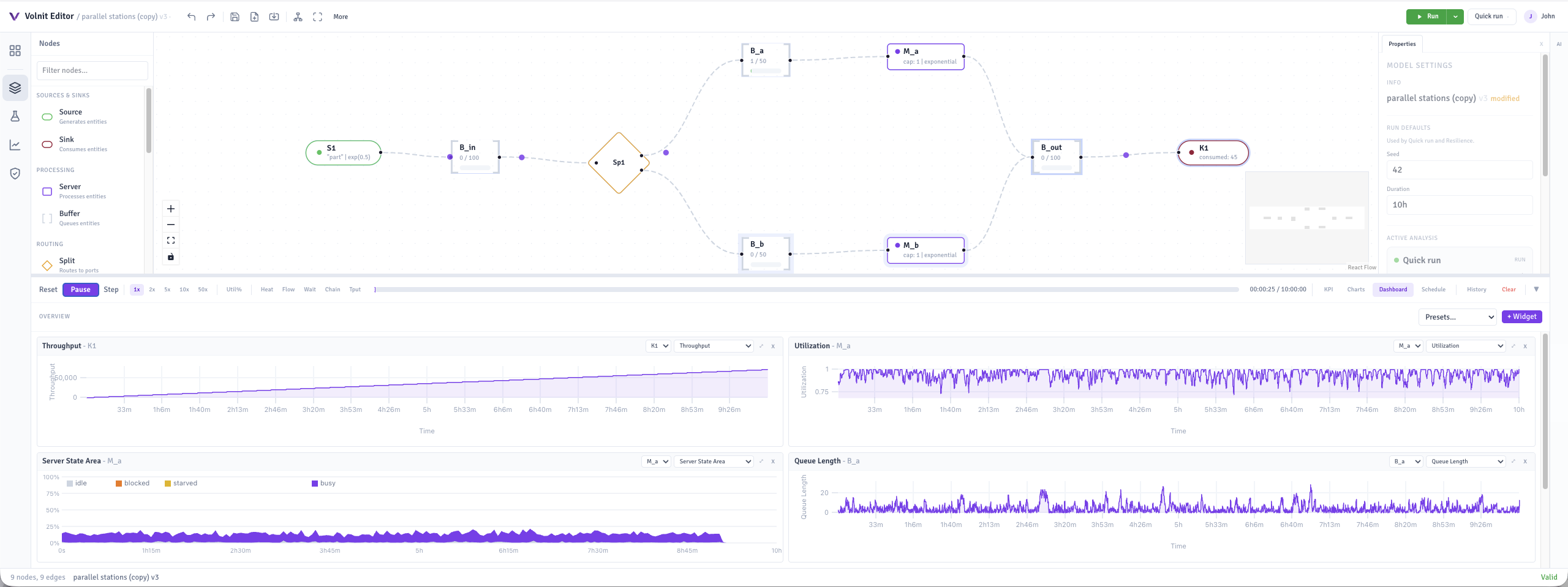
Answers your team can act on
Not a model to admire. Numbers for the next planning meeting.
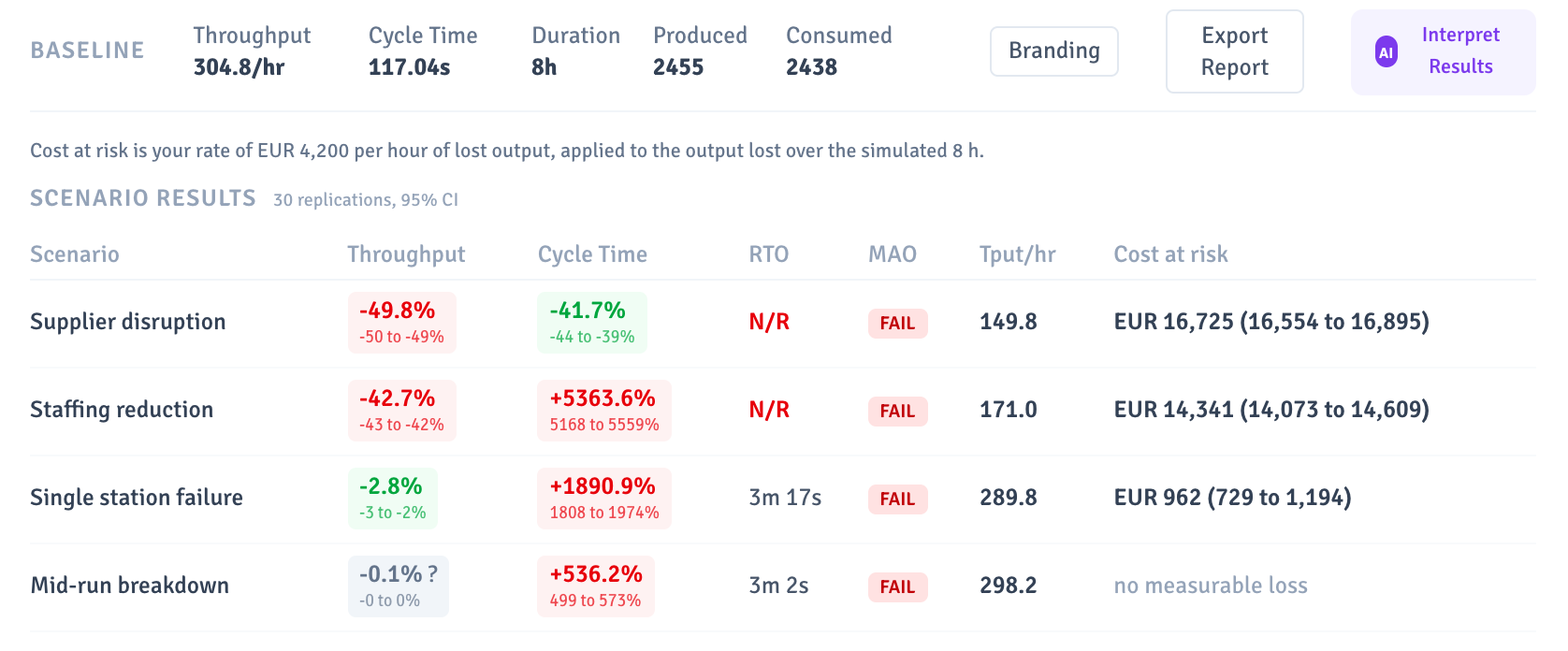
What a disruption costs you
Tell Volnit what an hour of lost output, or one lost unit, costs you. Every disruption you test is then shown as money at risk at that rate.
- Your own cost rate. We never supply or guess it.
- A range from repeated runs, not a single guess.
- The same figures carry into the risk report.
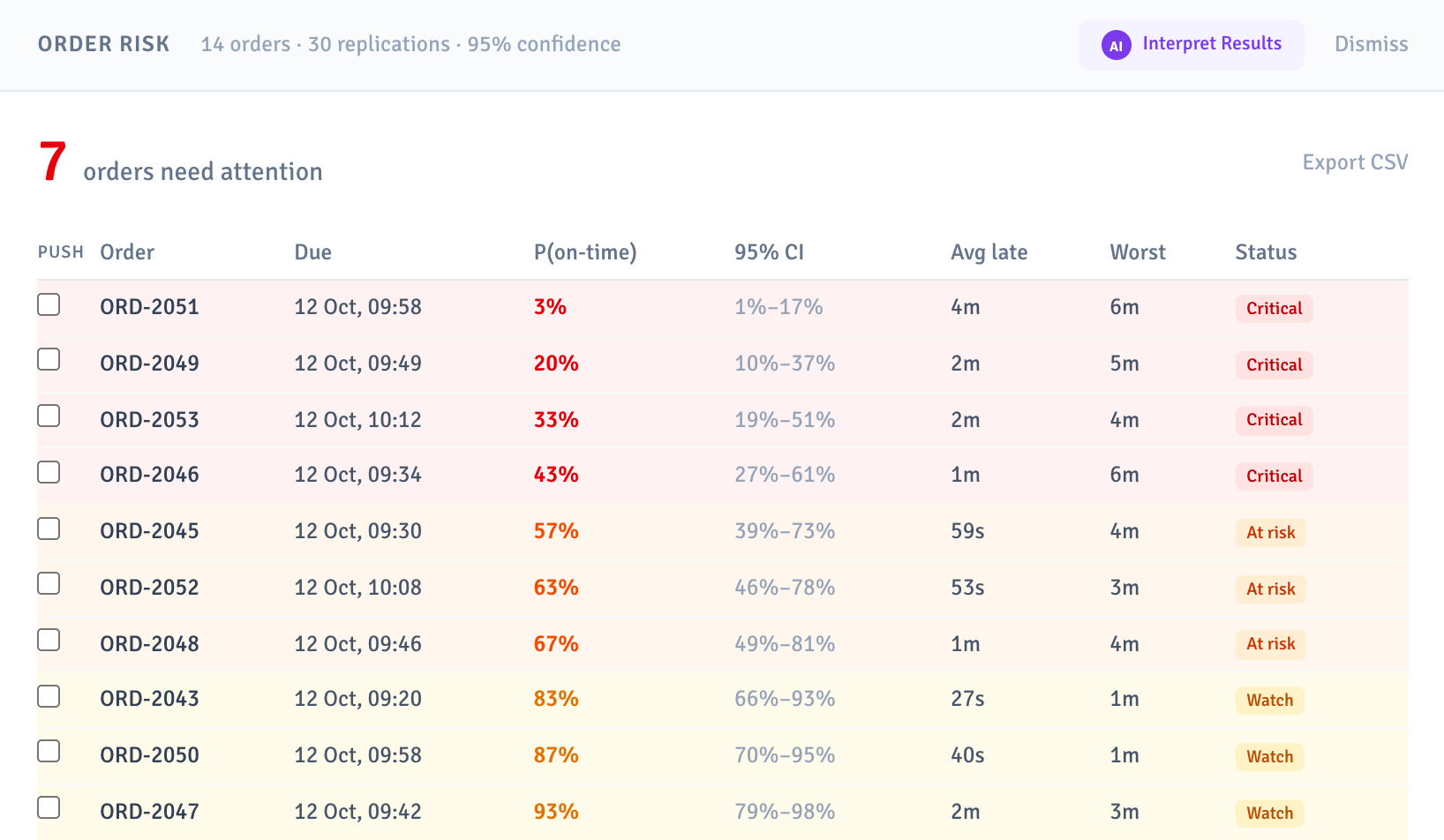
Which orders will ship late
Load this week's order book and see the chance each order ships on time, riskiest first.
- A confidence interval on every order.
- Compare dispatch rules, or expedite an order and see who it costs.
- Export the list to CSV for the planning meeting.
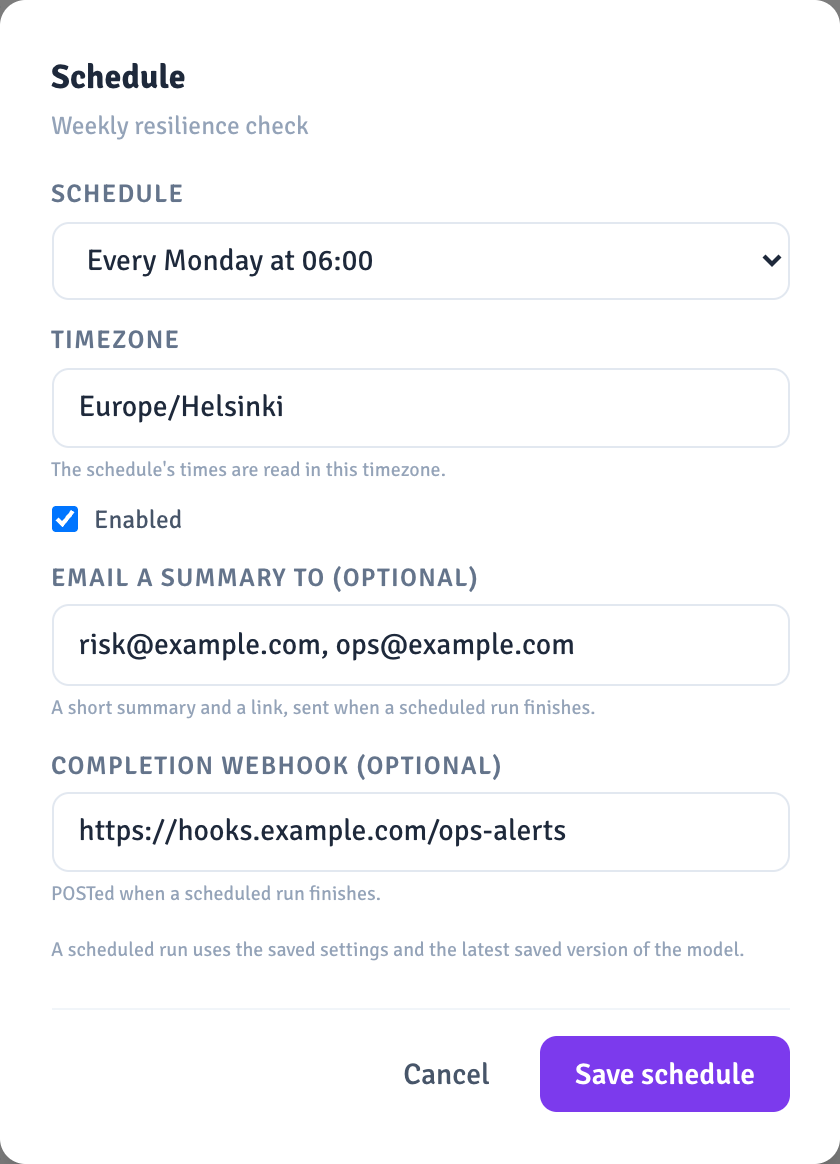
Know when the risk changes
Save an assessment and put it on a schedule. It re-runs on the latest saved model and tells your team when it is done.
- Daily, weekly, monthly or custom, in your timezone.
- A webhook to Slack or Teams, or an email summary with a link.
- Refresh the model from CSV or Excel so each run uses current data.
From words to risk assessment
No simulation expertise required. Describe your operation, the AI builds the model and interprets the risk.
AI generates a validated JSON model ready to run
QA_Inspector is a single point of failure.
At 94% utilization, any disruption cascades immediately. A 2-hour breakdown drops throughput by 100%. Adding a second inspector eliminates the SPOF and reduces recovery time from 47 minutes to under 5.
AI identifies vulnerabilities and recommends mitigations
The AI copilot is built into the editor, and is also available through the REST API and Python SDK. The engine quantifies the risk - the AI makes it actionable.
How it works
From operation to risk assessment in four steps.
Map your operation
Describe your operation as a flow of stations, queues, and resources. Use the visual editor, start from a template, or let the AI build it from a plain-English description.
Stress-test for vulnerabilities
Run SPOF analysis and disruption scenarios automatically. The engine fails every station in turn and repeats each scenario many times, so every result carries a confidence interval instead of a single guess.
Quantify risk exposure
See exactly which failures hurt most, how long recovery takes, and which mitigations are most effective. Optimize for resilience within your constraints.
Act, then keep watching
Present stakeholders with a risk report backed by data, with the money each vulnerability puts at risk at your own cost rate. Then schedule the assessment so you hear when the risk changes.
See it in action
Everything you need to quantify operational risk
From single-point-of-failure detection to full disruption scenario analysis with statistical confidence.
Single Point of Failure Analysis
Automatically test the failure of every station in your operation, one by one. Get a ranked list of the failures that would hurt you most.
Cost at Risk
Enter your own cost of lost output, per hour or per unit. Every disruption result is then shown as money at risk at your rate, with a range.
Recovery Time Estimation
Measure how long your operation takes to return to normal after a disruption, and get a pass, warning or fail against the outage you can tolerate.
Disruption Scenario Testing
Define what-if disruptions - machine failures, supplier delays, staffing shortages - and see the effect of each on throughput and recovery.
Per-Order Delivery Risk
Load your order book with due dates. See the chance each order ships on time, sorted riskiest first, and compare dispatch rules before you commit.
Scheduled Assessments and Alerts
Save an assessment and run it daily, weekly or monthly in your timezone. Get the result by webhook to Slack or Teams, or as an email summary.
AI Copilot
Describe your operation in plain English and the AI builds a validated model. After a run it explains the results, the cascade effects and the mitigations worth testing.
Runs on Your Real Data
Paste measured times and the right distribution is fitted and applied for you. Load this week's orders or machine availability from CSV or Excel - no integration to build.
Statistical Risk Quantification
Every risk metric comes from 30 or more replications and carries a 95% confidence interval. Know the range of disruption impact, not just the average.
Optimization and Sensitivity Sweeps
Set an objective and constraints and let the search find the best feasible configuration. Or sweep machine speeds, buffer sizes and staffing to see what matters most.
Real Schedules and Failures
Model shift patterns, breaks, holidays, and random machine breakdowns. Assess risk under realistic operating conditions, not idealized ones.
Model Any Operation
Production lines, warehouses, hospitals, call centers. 14 configurable building blocks cover machines, queues, conveyors, AGVs, shared staff pools, and more.
Browser-Based, API Included
Build and analyze your operation from any modern browser - nothing to install. Assessments run on a cloud engine, and every capability is also a REST endpoint.
Deterministic Reproducibility
Same inputs always produce identical risk assessments. Integer-precision time. No floating-point drift across platforms. Audit-ready results.
Built for Teams
Single sign-on, Admin, Operator and Viewer roles, team invites and a full audit trail. Use our hosted service or deploy on your own infrastructure. ISO 22301-aligned risk reporting.
Operational risk intelligence across industries
Any operation with flow, queues, and processing - we quantify its risk.
Manufacturing
Identify single points of failure across your production line. Quantify the cost of each machine breakdown, validate equipment investments against disruption risk, and prove resilience to auditors.
Logistics & Warehousing
Stress-test sorting systems, AGV fleets, and conveyor networks against peak-season surges and equipment failures. Know which failures cascade before they happen.
Healthcare
Assess patient flow resilience through EDs, labs, and clinics. Quantify staffing risk under surge scenarios and identify capacity bottlenecks before they affect care.
Service Operations
Call centers, checkout lanes, airport security. Measure how arrival spikes, staffing gaps, and system failures impact service levels with statistical confidence.
See where your operation breaks before it does
Start with a pilot: we get your team running on Volnit, with your own operation as the first model and your own data behind it. No simulation expertise required.